Wednesday, November 8, 2023

Call to Action

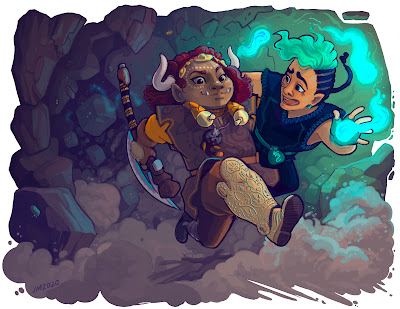
In the midst of a cave-in, an essaruk barbarian with a prosthetic lower leg is running for safety. She has a battleaxe in one hand and a frightened comrade — an elf sorcerer — carried under the other arm.

The action economy of the CORE20 RPG has been designed to give characters and their foes a maximum amount of flexibility in determining what they do in any given round while the game is in initiative, and to make sure that players are able to make meaningful choices regarding the actions they can take each round. As with most parts of CORE20, if you’re familiar with any d20-based fantasy game, you already understand the basic setup of how things play out round by round while the game is in initiative. If you’re primarily familiar with 5e D&D, you’ll note some differences, though — which will actually make CORE20 that much more familiar to players of 3rd edition and 4th edition D&D.

Chapter 5 Excerpt (Player's Guide) — Action Economy Preview

As detailed in the preview, everything your character might do in the game can be accomplished as a standard action, a minor action, a move action, a free action, or a reaction. There are a number of regular activities in the game that are locked into specific action types. For example, making weapon attacks or casting a spell is always a standard action by default. Drinking a potion is always a minor action, as is first pulling that potion out of an accessible pocket, pouch, or bandolier. Moving your speed, or shifting half your speed to avoid opportunity attacks, is always a move action. But for the many, many other activities your character can attempt, the setup of standard action, minor action, and move action is meant to allow GMs and players to quickly decide on what type of action fits the activity best. 

Making an Acrobatics check to slide down a bannister in the governor’s mansion? Because it involves movement, that’s a move action. Smashing a window open to jump through it while escaping a zombie horde? If the window is solid enough that smashing it takes most of your focus and attention, it’s a standard action. But if you can smash through it without needing to fully focus, a minor action is more appropriate — leaving you free to get off one last attack or spell before you flee.

The setup of actions in CORE20 is also designed to maximize your options for what your character can do while the game is in initiative. In most rounds, a character will use their standard action to make a weapon attack or cast a spell; use their minor action to make a quick skill check, grab up useful equipment, get the drop on their foes, or hold their turn; and use their move action to get into or out of position. But if you’ve got a reason to want to forgo that standard-action spell or attack in order to move twice on your turn, you can do so. If you want to give up your standard action to use a minor action instead, you can do that too. By forgoing your standard action and your move action, you can even take three minor actions on your turn if you want to — and there are many times in the game where doing so makes sense.

The initial part of this preview excerpt also talks about the way the game handles adjustments to your die rolls, which can take the form of bonuses, boons or banes, and advantage or disadvantage. Bonuses and advantage are familiar to anyone who’s played 5e D&D, while boons and banes are originally from the Shadow of the Demon Lord RPG by the amazing Robert J. Schwalb, and have been ported into CORE20 with Rob’s generous permission.

The final part of the preview then talks about action points — a mechanic that gives player characters an option to shift the balance of probability and fate in their direction just a little bit. Every character has one action point by default, granting the ability to take an extra move action or minor action, to convert a critical hit against them into a regular hit, to automatically recover while dying, and much more. But just as with everything else in CORE20, action points are gained by taking a feat — Heroic Action — letting you build a character whose adventuring exploits show off a legendary touch of good fortune.

(Art by Jackie Musto — http://www.jackiemustoart.com)

Wednesday, October 11, 2023

The Means of Magic

On the edge of a rise, beneath a gnarled tree, a glowing sword stands hilt-up where it’s been driven into the ground.

One of the issues that’s dogged Dungeons & Dragons since the beginning is the eternal dichotomy between magic items being really freaking cool, and magic items getting kind of redundant because your characters just keep on collecting them forever. The fiction that fantasy gaming is inspired by has a radically different setup, creating scenarios where the finding of a magic blade or wand is a capstone moment in the single adventure that defines a protagonist’s life. But the protagonists of our games don’t stop at one adventure, and neither does their hunger for magic loot.

Chapter 2 Excerpt (Magic Grimoire) — Magic Items Preview

As long as magic items last eternally, every new magic item found in the game undercuts the awesomeness of all the old magic items sooner or later. Magic items feel important at the big moments in a character’s life — a sword claimed from the destruction of a battlefield, a ring seized from a fallen foe, a staff hidden away in a tomb for a dozen generations, and on and on. But as characters rack up more big moments and the magic that comes with them, older items that once felt memorable are inevitably set aside, becoming little more than footnotes in a life story of adventuring.

Games that make attempts to create a magic item economy — including third and fourth edition D&D — make this process a little easier to deal with by creating a sense that magic items are meant to be sold off at some point. But the scale of that economy seldom makes complete sense, built as it is around the paradigms of 1) adventurers are rare sorts of people, 2) magic items are so obscenely expensive that only adventurers can afford them, and 3) if the market is so small, why are so many magic items being made that old dungeons are all somehow full of them?

There are lots of different ways to try to shape a better approach for magic items from a world-building perspective. Chief among those are the easy options of carefully limiting magic items and absolutely not worrying about where they come from. (To cover all its bases, D&D 5e wholeheartedly embraces both approaches.) 

CORE20 takes a different approach, though, by working with the idea that magic is ubiquitous in the world, known to and made use of by most people. This ubiquity is driven by the idea that magic items are relatively inexpensive and freely traded, making up an important part of the world’s economy rather than just being the overpriced toys of adventurers and villains. And what makes both those ideas work is that magic items in CORE20 don’t last forever.

The workaday magic items known to every edition of D&D and pretty much all other fantasy roleplaying games, from weapons to armor, wands and scrolls, magic rods and idiosyncratic one-off items, are imbued with magic that’s ephemeral. It fades over time, with the magic of potions and scrolls draining away within months if they aren’t used, to weapons and armor fading more slowly but never lasting the length of even a moderately successful adventuring career.

Because magic items don’t last forever, their value within an overall economy makes them pricey but not preposterous. An ephemeral magic potion of cure light wounds kept on hand by a village healer for emergencies costs 5 gp — a week’s wages for an average laborer in CORE20. The magic of an ephemeral longsword +1 found as treasure has a nominal value of 200 gp, consistent with the value of a great many nonmagical luxury goods, but not in the same ballpark as multiple years’ laborer’s wages or the cost of a modest house. (In CORE20, an open magic-item economy and a more restrained baseline for the cost of magic means that characters earn a bit less for adventuring than they do in traditional D&D, whose biggest problem is giving characters things to spend their money on. But that’s a topic for another update.)

Ephemeral magic gives characters the opportunity to naturally set magic items aside when those items fade. But it also gives them the opportunity to decide that a favored weapon or magical implement is worth keeping around, because the same economy that fuels the creation and trade of ephemeral magic items also allows those items to be remagicked — and at a lesser cost than crafting or commissioning an item as brand new. In this way, magic items become another part of what builds the story of a character’s adventuring life.

(Art by Chris Yarbrough)

Wednesday, September 13, 2023

The Way of the World

A map detailing a range of settlements and features. An area called the Duchy of Liana is at center, containing the cities of Swithins, Iandros, Rian, Elest, and Elpios. Across the border in the territory of the Duchy of Mundra, south of the Nystrala Mountains, is the open territory of the Free City of Yewnyr.

A majority of fantasy RPGs, starting with original Dungeons & Dragons, present themselves as being setting agnostic, not tied to any particular campaign world. Sometimes a setting-neutral game will end up with a bunch of possible official settings it can be attached to (as with contemporary D&D). Sometimes, it’s explicitly assumed that GMs and players will build their own worlds for a game (as with original D&D).

Even without a default setting, though, in the way fantasy RPGs set out rules for characters, magic, technology, conflict, and more, those rules inevitably end up saying a whole lot about a game’s expectations for its world.

Chapter 7 Excerpt — The World of Isheridar

Sometimes, the rules of a game make small statements. Like how prior to fifth edition D&D, every character knew the price of a horse but you couldn’t buy a camel off the shelf. Or how even in 5e, cinnamon, pepper, cloves, and saffron are named as valuable commodities, establishing that your games are expected to be set in lands far from places where such spices are grown, whether you want them to be or not.

Sometimes, the rules of a game make bigger statements. Like which of its many sapient peoples are automatically evil for some reason, implying that our games are set in a colonialist milieu. Whether we want them to be or not.

In CORE20, there’s a specific relationship between the world of the game and the rules — even though the world of the game probably isn’t going to be the world that other GMs and players make use of. Surveys of GMs routinely show that fully half run their own homebrew worlds, on top of the many GMs who use published campaign settings less as a fixed foundation and more as a starting point for their own world-building. 

At the end of the day, it’s my full expectation — and honestly, my deepest desire — that GMs and players play CORE20 in worlds of their own devising. But at the same time, the setup of a world called Isheridar touches on and inspires the rules of the game and the underlying vision of the CORE20 system at many different points. 

This preview covers a broad swath of information about the world of Isheridar — the world of my own gaming and fiction — which has inspired CORE20 as it’s grown alongside the game. This section of the core rules sets out the foundation of how the game and its rules relates to that world, so that GMs can best relate the game to worlds of their own. It creates a framework for understanding how a broadly civilized cultural mosaic can share a landscape with forgotten dungeons and monster-haunted ruins. It talks about the broad patterns in traditions of faith across uncounted cultures. It talks about the way in which conflict and adventures can derive from any number of sources, with the specific exception of the folk of certain worldly lineages being uniformly cast as feral oppressors. 

This section of the rules digs into the reasons why characters take up the call of adventure and the path of heroism. It explores the understanding of what it means to be a hero in a world on the cusp of history, standing between a past that’s been shattered and a future that no one can see.

Thursday, August 10, 2023

Stories and Spells

In a marketplace, a pale-skinned, blond-haired woman with a prosthetic hand and a cloaked figure are both looking at a crystal ball, within which the image of a dragon appears.

As talked about in the previous preview, magic is the place where fantasy begins and ends for me, and spell magic is the most prominent manifestation of how magic is meant to feel in the world of a CORE20 game. This is true for all characters, not just adventurers, and regardless of whether those characters channel spell power themselves. A warrior focused on training and battle, an outlander wandering the wilderness, and a scoundrel dedicated to social niceties and shady deals have no reasons to understand even the basics of the workings of magic. But the spells that map out the presence of magic in the world are as real to those characters as the mythic heroes and distant lands they’ve heard of but have never seen. 

Chapter 1 Excerpt (Magic Grimoire) — Spells

Spells aren’t just mechanics and flavor for certain characters, in other words. They’re a part of each character’s broader understanding of the world’s vastness and scope, and the starting point of what makes a milieu magic. Spells take the mystery and threatening potential of the eldritch power that suffuses the world, then turn that into the promise of personal power, of an edge in battle, of health and protection from harm. The potential of magic to change the world is summed up by spells, turning them from just a list of options on a character sheet into touchstones that make the magic of the world feel personal.

Spells help define the different ways in which magic manifests within the world, marking out the dividing lines between the traditions of animyst magic (CORE20’s term for divine magic), arcane magic, and druidas magic. The distinctions between the secret workings of those spellcasting spheres in the world of the game is a topic of such complexity that only a rarefied group of lorists and sages can claim to understand it. But every child who grows up hearing tales of adventure uses stories of spellcasting to define a personal sense of the differences between the enlightening and vengeful life magic of animysts, the unpredictable and unforgiving eldritch power of arcanists, and the gentle and furious primal magic of the druidan.

CORE20 builds the setup of its magic item system on the foundations of third edition D&D — and then kind of doubles down on 3e, creating a game milieu in which magic is an integral and essential part of life across all the world, not just the world of wealthy adventurers. Among other things, this gives us a system in which potions and spellmarks (a magic item that functions exactly as a potion, but which takes the form of a small breakable object such as a tile) can encompass a wide range of lower-level spells. And that in turn means that spell magic is something of potential in-game interest to every character, not just spellcasters.

When I talk about CORE20 being a magic-rich game, that translates to the spells chapter of the CORE20 Magic Grimoire currently sitting at 609 spells. That’s a bit of a jump from fifth edition’s 361 spells in the Player’s Handbook, and a modest step head even of the 500-odd spells available in all 5e books to date. This preview details the full lists of animys, arcane, and druidas spells, running from levels 0 to 18. (CORE20 spreads out the traditional D&D setup of 1st- to 9th-level spells into 1st- to 18th-level spells, so that spell level and caster level sync up.) It then shows off a relatively small selection of 120 or so of those spells. This includes a number of eldritch classics with mechanics and presentation thoroughly revised for the CORE20 game, some standard spells that have been given a new spin with updated mechanics, and some brand-new stuff to help make the world of your CORE20 game magic.

(Art by Dean Spencer)

Tuesday, August 1, 2023

Magic Makes the World

A dark-skinned, russet-haired spellcaster stands at the ready, blue magic flaring in each of her hands.

From a design and mechanics perspective, magic and spellcasting in D&D have always fascinated me, because they’re the original (and still-dominant) expression of a mini-game existing within the main game. The rules for spellcasting have always effectively been a game of their own. They build on the baseline rules of the game, for sure. But they take those baseline rules to extents and in directions that exist nowhere else in the game. So this week’s preview explores those extents and directions in CORE20, showing how the spellcasting rules let characters bring magic to life.

Chapter 10 Excerpt — Spellcasting

For me, magic has always been the most vital and visceral part of fantasy, both in gaming and fiction. I love the way that magic defines a world and the people in it. I love thinking about the ways in which magic might change worlds that resemble our own, and I love building campaigns in which magic as a tool of good or evil shapes the play of the game. I suspect it thus won’t be a huge surprise for anyone to learn that CORE20 is suffused with magic on every level.

(Important to note: This doesn’t mean you can’t play a low-magic game using CORE20. One of the central foundations of the game is that all its various rules systems are modular and optional, and downplaying the presence of magic and spellcasting in the world is dead easy. That’s a full topic for another post, though.)

CORE20’s baseline approach to spellcasting will be familiar to anyone who’s played any version of D&D (as will the spells in the game, which will be the next preview). But the need to separate the progression of spellcasting power from rigid class mechanics sets up some cool CORE20 differences from the D&D baseline. Some of those differences (spell points as opposed to spell slots, for example) are actually still very much D&D, having been built on ideas from the 3rd edition supplement Unearthed Arcana (one of the few non-core 3.5e books whose material was published under the OGL back in the day).

The spellcasting chapter of the game covers a lot of material, as it pulls together all the information and rules traditionally spread out in a spellcasting chapter and the write-ups for the game’s spellcasting classes. It then expands into new options for magical characters that go beyond the baseline game, and which feed the essential CORE20 paradigm of letting players build characters in ways beyond what traditional class setup allows. But there are still three spheres of magic that define spellcasting — animys, arcane, and druidas, with “animys magic” being CORE20’s term for what D&D calls “divine magic.”

In the world of the game, animys and druidas casters draw on common magical history, marking how animys magic first developed as an offshoot of druidas traditions. Arcane spellcasting shares a common form with the life magic of animys and druidas casters, but is built on distinct traditions and more mysterious sources of magical power. But the similarities in the three spheres of spellcasting overshadow any of their differences, creating a framework that helps define the importance and prevalence of magic in the world.

(It’s worth mentioning that there are actually two other spellcasting traditions in the game. Spelltouched magic allows characters to channel one or more specific spells innately rather than as learned spells. And primordial magic is the older, more chaotic form of arcane channeling that gave rise to the more codified traditions of arcane casting. But we’ll look at those another time.)

(Art by JE Shields)

Wednesday, July 5, 2023

When the Spirit is Willing

A warrior in battered armor stands at the ready, preparing to take on an unseen foe. Behind them, their ghostly knight companion stands ready to fight at their side.

I got an email recently from someone following the playtest previews, who asked if the abundant character-creation options in CORE20 meant that you could play a ghost in the game. I’m sorry to report that the answer is no — for now, at least. (That idea is actually pretty intriguing, because the same process of building a character by selecting feats representing training and insight should work just fine for selecting feats that represent broader supernatural power.)

But I also mentioned in reply that you can have a ghost as your best friend in the game, which I think is pretty awesome. The spirit guide is one of the game’s two featured companion types, alongside the companion creature (a broader version of D&D’s animal companion).

Chapter 7 Excerpt — Spirit Guide

The idea behind the spirit guide is that a bond created by a character and an NPC, a faithful companion creature, or even a sworn nemesis can be so strong in life that not even death can break it. A spirit guide has a spectral physical appearance, but isn’t incorporeal or undead. Rather, they’re transformed by death into a celestial creature whose physical form can be reshaped at their whim, and whose bond with their chosen character defines their renewed existence.

The spirit guide is relatively new addition to CORE20, and came about when a player in my main and long-running playtest campaign had a story idea for their character — a stoic dwarf engineer, dabbler in personal magic, and bath aficianado named Ruh. During Ruh’s initial appearance in the campaign, he was in self-imposed exile, having left his wife Caralah behind in his homeland some three hundred leagues distant. So during a long downtime break for Ruh that saw him return home, the player crafted some campaign narrative detailing that Ruh and Caralah had made a solo journey to return a powerful relic stolen to its rightful resting place after it was stolen by adventurers years before. Only during that adventure, Caralah was struck down by a magical malady that claimed her life and put her beyond the reach of resurrection. 

The player’s initial idea was to establish that the fell magic that had claimed Caralah had somehow preserved her spirit in a way that would let her speak to and through Ruh, allowing her to appear in the campaign as a noncombatant NPC, but without adding an additional body to the party. The player had in mind that his future feat selections could reflect knowledge that Caralah was passing onto him, letting the love of Ruh’s life effectively ride shotgun on his return to the main party.

I said I loved that idea a lot… but that we could probably go one degree better with the concept.

A few iterations later, another memorable spirit guide (part of my current campaign, in fact) is Beros, the spirit of a faithful childhood pet. Beros is companion to Thalia, a notary field agent of a healing order dedicated to the old gods of death, whose village was struck by an earthquake years before. The brave Beros worked tirelessly in the aftermath to rescue survivors, but died in a landslide while doing so — then came back as a brave spirit guide and a very, very good boy.

Spirit guides are awesome.

(Art by Indi Martin © 2015)

Thursday, June 8, 2023

The Paths of the Past

A desolate cavern is lit by a distant yellow glow, revealing glistening pools and hanging vines. A figure holding a staff stands in silhouette, preparing to enter.

Backgrounds in CORE20 serve the same purpose as in most other fantasy RPGs — letting you shape a sense of where your character came from before they took up their current path of noble questing, dark-hearted revenge, or dungeon-based get-rich-quick schemes. But CORE20 backgrounds take a slightly different approach than in many other games, covering only the broad archetypes of criminal, exile, gentry, magical, military, outlander, rural, urban, and wanderer. That’s because each background is designed to let you create a baseline canvas showing where your character came from — then allow you to paint the specifics of your backstory with your feat choices and the languages, bonuses, and benefits your background grants you. 

Chapter 4 and 7 Excerpts — Background and Languages

If you want to play a soldier, a sailor, a reformed cultist, a sage, or what have you, that’s great. But CORE20 has no unwieldy list of dozens of backgrounds for those and other specific paths. Rather, your initial skill bonuses and feats reflect what the experience of any of those specific life paths have taught you, juxtaposed against the foundational story of your earlier life that your background defines. Your choice of background provides you with an ability score increase, bonuses to be applied to personal and background-related skills, and your choice of a range of background benefits. And as with all aspects of the CORE20 system, customization is the norm, letting you work outside your background’s suggestions for ability score increases and skill choices if you like, and letting you come up with your own background benefits if you want to fully personalize your character’s journey.

Another thing your background provides you is your languages, so that section (from the “Life and Adventuring” chapter) is also part of this preview. Just as backgrounds are meant to provide the backdrop on which you define your character’s place in the world, languages help to define the feel of that world. CORE20 takes the usual languages of fantasy gaming as a starting point, then pushes into new territory by establishing that spoken languages and sign languages are equally widespread and universally used across the world. That setup was a notion that stuck in my head from the earliest days of reading about drow sign language in AD&D, thinking about how much sense it would make for sign language use to be widespread in places where people were routinely stalked by monsters — and then realizing that that described pretty much everywhere in a fantasy RPG world. Huge thanks are due to the disability and sign language consultants whose insight and suggestions helped turn my initial scattered fantasy thoughts on sign languages in the game into something more firmly rooted in the real world. Moving CORE20 as far away as possible from the ableist foundations that a lot of contemporary fantasy has always been built on was an important goal for the game, and I’ll have more to share on that topic in upcoming previews.

(Art by Daniel Comerci)

Ye Olde Magic

As it is in most fantasy RPGs, magic and spellcasting is a central pillar of the game and the world of CORE20. “Magic Among the Worldborn” i...