Tuesday, January 30, 2024

The Hit (Points) Parade

A brawler with brown skin and short dark hair wears loose robes and braces, carrying no weapons. Even though they are badly bloodied with one eye swollen shut, they stand defiantly, ready for the next stage of the fight.

I’ve talked about how the game that has become CORE20 goes back to a first set of house rules I worked up more than ten years ago. But there’s actually one part of the CORE20 rules that goes back to twenty-four years earlier than that — critical points and defense points (written up in chapter 9 of the CORE20 Player’s Guide), which were a house rule set up for my AD&D games way back in the day.

“I Can Do This All Day…”

As it does for a lot of people, the abstract quality of D&D’s hit point system has long vexed me. I mean, it works fine for the most part. It’s not broken per se. But the idea of “Well, sometimes your hit points are actual physical damage to your body, and sometimes your hit points are luck, and sometimes your hit points are your ability to parry most of a blow away” always felt a bit weaselly to me. This is a less serious problem at lower levels, when the amount of damage characters can dish out and withstand is still relatively nuanced. But by the time a 10th-level barbarian can throw themself blindfolded off a 200-foot cliff and know that the fall has no chance of killing them, things start to feel iffy for me.

Way back in 1986, the idea came to me of breaking hit points out as two different numbers — critical points representing how many potentially mortal wounds your body can take, and hit points (I didn’t call them defense points then) representing your ability to avoid mortal wounds through training and skill. That original system was a bit more complicated than the CORE20 setup (because I was young, and because the one thing AD&D really needed was more complication). But the baseline idea of having one number representing your actual health and another number representing how good you were at rolling with attacks that would otherwise mess your health up started there.

Fast-forward a whole bunch of years, and in 2004, I dusted off critical points and hit points for my D&D 3.5e campaign. An updated take on those rules was inspired by my reading (and taking the useful improvement of using Constitution score as a baseline for critical points from) the vitality and wound points system in the 3.5e Unearthed Arcana supplement, with that setup itself sourced from the d20 Star Wars RPG. Then when one of my 3.5e campaigns became the initial test bed for CORE20 (or d20 CORE as the initial house rule experiments were called), critical points and defense points were ready to go.

Critical Thinking

The CORE20 hit point setup using critical points and defense points does a whole bunch of the things in the game, all by design. Chief among those is that it makes critical hits really freaking exciting when it’s the player characters hitting their enemies — and it makes critical hits really freaking scary when it’s the enemies critting the characters. Because a character will absolutely go down when their critical points drop to 0, even if they’ve got a ton of defense points remaining, the first critical hit in a combat encounter can throw everything into upheaval. Especially for non-martial characters who don’t have a ton of critical points or easy access to temporary hit points as a buffer, a character taking a critical hit can necessitate a huge change in tactics, as that character taking a second critical hit becomes a thing the whole party needs to worry about.

Another thing that critical points and defense points do is make starting characters and lower-tier enemies more robust than the standard that D&D has long applied to low-level characters and their foes. Because all creatures have critical points built on their baseline Constitution score, that’s an average 10 hit points for every starting character and every worldborn NPC, even before monster math and feat selection build that up. Creating a 4 hit point wizard in CORE20 is technically possible, but you’d have to seriously work at it. As a result, even starting characters not focused on standing at the center of combat each and every encounter have an excellent chance of surviving their starting adventures.

Monsters likewise get a hit point boost from their default critical points. As an example, consider the lowly stirge — a creature weighing in at a mighty 5 hit points from AD&D 1e through 3.5e, before budget cutbacks reduced them to 2 hit points for 5e. At 5 critical points and 10 defense points, the CORE20 stirge is relatively weak even for a tier 0 creature (because Tiny and smaller creatures gain only part of their Constitution score as critical points). But in a combat where a 9/5 hit point arcanist takes on a 5/10 hit point stirge, both have a damage buffer that can make the fight more interesting.

One of the things I’ve long observed and been often frustrated by is that lower-level combat encounters in D&D can too easily swing wide one way or the other if all of one side acts first in the initiative order. When the characters all go first, the six foes they’re facing are suddenly three foes before the enemy side gets to act, and the fight is a rout. If all the monsters go first, half the characters start the fight bloodied or one character starts out already down and dying, and the party’s planned tactics go out the window to prioritize healing. But by having just a little bit of a hit point buffer, those sorts of first-round “Whoops!” moments become less likely.

As well, another benefit of lower-tier characters and creatures in CORE20 being a bit more robust is that it gives players and GMs options for getting out combat when one side would normally just demolish the other. Using the stirge as an example, with 2 hit points in 5e, one successful attack against a stirge slurping on a character all but automatically ends with a dead stirge. But with the 5/10 hit point CORE20 stirge, the GM often has the option to say, “You smash the stirge soundly, making them decide to take their 3 remaining critical points and fly off.” Likewise, just as starting characters being one-shot by ogres is less of a thing in CORE20 than in D&D, starting characters one-shotting bandits and cultists becomes a touch less likely unless that’s something the characters are interested in doing. In games with players who don’t automatically want to kill every creature they meet, this can be a good thing.

• 

Questions about hit points or anything else in CORE20? Email CORE20@insaneangel.com or join us on the CORE20 Discord server and ask away!

(Art by Eric Lofgren)

Tuesday, January 16, 2024

“And hark! What Discord follows…” — Shakespeare

The CORE20 logo with the Discord logo — a slightly anthropomorphic videogame controller — inset into the letter O.

Checking out the CORE20 RPG? Looking for a place to ask rules questions, get updates, or talk about the game? The CORE20 Discord is now live!

Plans for the Discord are ongoing, but we’re looking to create a one-stop space where players and GMs can stay ahead of any playtest issues and updates while sharing what they’re doing with the game. Use the invite below to join us!

https://discord.gg/NaGnNSVRDF

And regardless of whether you Discord or not, questions about any aspect of the game or the playtest can always be sent to CORE20@insaneangel.com.


Thursday, January 11, 2024

Tales of Adventure

An enormous monstrous spider assault three adventurers, driving a taloned leg through the body of an armored warrior, forcing another warrior back as the spider explodes in flame, and burning another adventure down to the bone.

Running a CORE20 campaign? Got a party of heroes all dressed up with nowhere to go? Then check out the first of an eventual bunch of free starter adventures for the CORE20 playtest:

http://tinyurl.com/CORE20Playtest

(If the short URL doesn’t work for you, you can click or copy the full link here.)

Have a look in the “CORE20 Starter Adventures” folder and grab Sapirio’s Secret, a tier 1 adventure entirely suitable for brand-new starting characters. The CORE20 version of Sapirio’s Secret is an adaptation of a 5e version written by Scott a few years ago, and dishes up a nice one- or two-session mix of roleplaying, humor, investigation, and combat against a group of most unusual magic-users.

More starter adventures are on their way, starting with a CORE20 adaptation of Zengran’s Game, a one-shot written by Scott as part of Fantastic Lairs.

Enjoy!

(Art by André Meister)

Thursday, December 28, 2023

Taking Things to the Next Tier

The cover of the CORE20 “Playtest GM Guidelines” with art by Xavier Beaudlet. At the bottom of a forest chasm, a flight of stairs leads up to the entrance to an ancient temple. Vines and undergrowth line the chasm walls, and a pale green light shines down from above. Two huge columns flank enormous double doors in the front of the temple, each set with a forbidding statue. The double doors stand open, revealing only darkness beyond.

After last’s week’s release of the player-facing components of the CORE20 rulesetthis week sees the rest of the full CORE20 playtest go live!

http://tinyurl.com/CORE20Playtest

(If the short URL doesn’t work for you, you can click or copy the full link here.)

On the other side of that link, you’ll find an extradimensional space on Google Drive that holds:

  • The full CORE20 Player’s Guide, featuring all the rules of the game for players and GMs.
  • The full CORE20 Magic Grimoire, collecting the many spells and magic items of the game.
  • The CORE20 Creature Playtest Package, featuring more than 180 foes, allies, and folk of the world from the eventual CORE20 Creature Compendium. The creature package comes in a regular and low-color version, and the introduction section explains why.
  • The CORE20 Playtest GM Guidelines, providing a brief overview of what a GM needs to run the game, and explaining why those guidelines aren’t the full CORE20 Campaign Guide.
  • A form-fillable character sheet.
  • A free starter adventure.
  • An About the Game doc talking about how we got here.

Carried in the wake of this tsunami of material, the CORE20 playtest is officially underway! What you’ll find in the playtest folder is everything you need to play CORE20… well, forever, really. Even without the full Creature Compendium and the Campaign Guide that’ll eventually provide guidance and advice to GMs about encounter building, campaign design, and more, the Player’s Guide and the Magic Grimoire contain all of the game. For free. Everything. Honestly, a bit more than everything (see the note in the About the Game doc for more about that).

As I mentioned in the previous CORE20 update, I’ve been working full time in RPGs for twenty years now. I’ve worked on a lot of amazing stuff over that time, alongside a lot of amazing people. But of all the things I’ve worked on, CORE20 means to the most to me. Thank you for letting me share it with you.

(Art by Xavier Beaudlet)

Wednesday, December 20, 2023

Game On

The cover of the CORE20 “Playtest Player’s Guide” with art with Xavier Beaudlet. Beneath a cloudy night sky, a red-haired warrior with a longbow in hand stands atop a rocky rise with their white tiger companion at their side. They watch a ruined tower in the near distance, which has lights glowing in two windows, a spectral apparition rising from the open ground-level entrance, and monstrous bats circling in moonlight above.

Today’s preview of the CORE20 RPG is a big one! Because it’s… well, most of the CORE20 RPG!

The full versions of the CORE20 Player’s Guide and the CORE20 Magic Grimoire are available for download right now:

http://tinyurl.com/CORE20Playtest

The “About the Game” PDF in the playtest files folder sets up what’s in those two books, and features the intro you’re reading right now. But it also has additional info about the game and some of the goals of the playtest process. The playtest package of wondrous foes and foils, allies and NPCs from the CORE20 Creature Compendium will be following next week, along with a quick GM’s overview of the game. And there will be some free starter adventures dropping soon after that.

I’ll be talking more on this very blog in coming weeks about the development of the game, what inspired it, how it’s changed (drastically in some cases) over ten years of play, and so forth. But one thing I can address here and now is the question of why I’ve done all this. And the answer to that, quite simply, is that CORE20 is a game I’ve wanted to play for most of my life, and it’s a whole hell of a lot of fun.

CORE20 is built around the framework of d20 fantasy, so it’ll feel familiar to anyone who’s ever played d20-era D&D, from 3rd Edition through 5th Edition. But it’s different. CORE20’s narrative-focused mechanics turning d20 rolls from a state of static pass/fail ennui into something more dynamic are meant to shoot shared-story fuel straight into the heart of the game. A foundation of freeform character building lets you do things as a player that class-based games sometimes struggle with. It lets you do things that class-based games simply can’t do. It lends itself to a wide range of play styles, including the option of running low-combat campaigns where you aren’t forced to just ignore your character’s default battle prowess. Rather, you get to swap the battle prowess you don’t need for things that are more important to who your character is and what you want them to do. 

I’ve been working on Dungeons & Dragons (alongside a few other RPGs) for twenty years now. Everything I’ve ever worked on has taught me something about the game that I didn’t know before. Every person I’ve been fortunate enough to work with has shown me new things about how this amazing hobby and its amazing design space have evolved. I know that fantasy RPGs are different for everyone. I don’t presume to know how you play, or the things that make the game the most fun for you. 

But after forty years of playing and after twenty years of working on the game, every single thing that’s ever made the game the most fun for me is in CORE20 somewhere. And I’m very, very proud and happy to share it with you.

(Art by Xavier Beaudlet)

Thursday, November 30, 2023

Opus Arcana

A dwarf crafter works to prepare a magical potion, watching as heat is applied to the contents of a green flask.

While partaking of the excellent Eldritch Lorecast last week, I listened to the team talk with increasing degrees of lament about the chronic lack of a solid magic item crafting system in D&D. Different approaches from different games and game systems were discussed at some length, along with the different goals that characters and players often have for magic item crafting. (For those interested, that discussion is here.)

In the end, the consensus was that there are simply too many different approaches the game can take to magic item crafting, and all those approaches typically fall flat at some point. It was then left to the uber-talented James Haeck (who I’ve been fortunate enough to have worked alongside on numerous projects) to comment that there’s likely no way to ever make everyone happy with a magic item crafting system unless there’s a genius game designer out there who can thread that needle.

And, well, here I am. đŸ˜€

Chapter 8 (Player's Guide) and Chapter 2 (Magic Grimoire) Excerpts — Magic Item Crafting Preview

CORE20 has a fairly straightforward and extremely usable approach to magic item crafting, because that approach is built on a number of straightforward and usable foundational steps. At the base of the process is the idea that in the game, characters have ways to earn income during downtime that are tied to their skills. The wages that a character can earn week to week during downtime are synced up with the wages earned by NPC hirelings in the game, with most characters’ advanced state of skill use letting them easily pull down expert hireling wages whenever they’re not actively adventuring.

The rules for crafting mundane items are in turn tied to the rules for earning income. The game’s crafting rules are built around the idea that instead of earning a certain number of gp working for someone else, a character can instead create weapons, art objects, armor, alchemical substances, and more at half cost. Effectively, a character crafting an item pays half the item’s typical market cost for raw materials and overhead, then provides their own labor for free.

Building on the rules for mundane item crafting, magic item crafting functions in exactly the same way — albeit at a higher level of artisanship and specialized knowledge. Creating magic items involves the labor of master crafters, magic users, and the item crafter, but when all those artisans come together, they do so using the same rules for crafting mundane items. (The thing that allows crafting magic items to use the same rules of in-game economy as crafting mundane items is the way that magic items fit properly into the overall economy of the CORE20 game world, as talked about in a previous update.)

At its heart, the CORE20 system is a game focused on letting characters and players do whatever they want to do as heroes in a high-magic world. Making it easy for characters to craft magic items as part of downtime, making use of their own skills and of the connections with other characters and NPCs derived from their adventures, is just another part of that.

(Art by Dean Spencer)

Wednesday, November 8, 2023

Call to Action

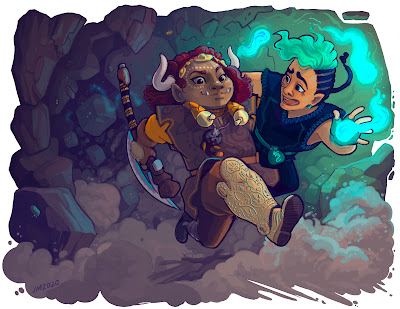
In the midst of a cave-in, an essaruk barbarian with a prosthetic lower leg is running for safety. She has a battleaxe in one hand and a frightened comrade — an elf sorcerer — carried under the other arm.

The action economy of the CORE20 RPG has been designed to give characters and their foes a maximum amount of flexibility in determining what they do in any given round while the game is in initiative, and to make sure that players are able to make meaningful choices regarding the actions they can take each round. As with most parts of CORE20, if you’re familiar with any d20-based fantasy game, you already understand the basic setup of how things play out round by round while the game is in initiative. If you’re primarily familiar with 5e D&D, you’ll note some differences, though — which will actually make CORE20 that much more familiar to players of 3rd edition and 4th edition D&D.

Chapter 5 Excerpt (Player's Guide) — Action Economy Preview

As detailed in the preview, everything your character might do in the game can be accomplished as a standard action, a minor action, a move action, a free action, or a reaction. There are a number of regular activities in the game that are locked into specific action types. For example, making weapon attacks or casting a spell is always a standard action by default. Drinking a potion is always a minor action, as is first pulling that potion out of an accessible pocket, pouch, or bandolier. Moving your speed, or shifting half your speed to avoid opportunity attacks, is always a move action. But for the many, many other activities your character can attempt, the setup of standard action, minor action, and move action is meant to allow GMs and players to quickly decide on what type of action fits the activity best. 

Making an Acrobatics check to slide down a bannister in the governor’s mansion? Because it involves movement, that’s a move action. Smashing a window open to jump through it while escaping a zombie horde? If the window is solid enough that smashing it takes most of your focus and attention, it’s a standard action. But if you can smash through it without needing to fully focus, a minor action is more appropriate — leaving you free to get off one last attack or spell before you flee.

The setup of actions in CORE20 is also designed to maximize your options for what your character can do while the game is in initiative. In most rounds, a character will use their standard action to make a weapon attack or cast a spell; use their minor action to make a quick skill check, grab up useful equipment, get the drop on their foes, or hold their turn; and use their move action to get into or out of position. But if you’ve got a reason to want to forgo that standard-action spell or attack in order to move twice on your turn, you can do so. If you want to give up your standard action to use a minor action instead, you can do that too. By forgoing your standard action and your move action, you can even take three minor actions on your turn if you want to — and there are many times in the game where doing so makes sense.

The initial part of this preview excerpt also talks about the way the game handles adjustments to your die rolls, which can take the form of bonuses, boons or banes, and advantage or disadvantage. Bonuses and advantage are familiar to anyone who’s played 5e D&D, while boons and banes are originally from the Shadow of the Demon Lord RPG by the amazing Robert J. Schwalb, and have been ported into CORE20 with Rob’s generous permission.

The final part of the preview then talks about action points — a mechanic that gives player characters an option to shift the balance of probability and fate in their direction just a little bit. Every character has one action point by default, granting the ability to take an extra move action or minor action, to convert a critical hit against them into a regular hit, to automatically recover while dying, and much more. But just as with everything else in CORE20, action points are gained by taking a feat — Heroic Action — letting you build a character whose adventuring exploits show off a legendary touch of good fortune.

(Art by Jackie Musto — http://www.jackiemustoart.com)

Ye Olde Magic

As it is in most fantasy RPGs, magic and spellcasting is a central pillar of the game and the world of CORE20. “Magic Among the Worldborn” i...